How to Register a Company in the UK The Right Way
Updated: Aug 8, 2025
Turning your business idea into a legal entity is a massive milestone for any entrepreneur. Officially, registering a company means choosing a legal structure, sorting out details like a unique name and director info, and then filing the application with Companies House. The good news? This can often be done online within 24 hours.
Your First Step in Company Registration
Setting up a company in the UK isn't just about paperwork; it's the moment your ambition becomes a real, recognised business. Think of this stage as strategic planning. You’re laying the foundations that will dictate your company's future responsibilities, how much personal risk you're taking on, and the way it operates. Getting this right from the start saves a lot of headaches later on.
The whole process revolves around Companies House, which is the UK's official registrar. Every single limited company in the country is on their books, making it the central point for both getting started and staying compliant.
Here’s a look at the Companies House homepage. You'll be spending some time here.

As you can see, the site points you straight to the key tasks: filing information for your company and looking up details on others. This highlights its dual purpose it's not just for registration, but for public transparency too.
Core Concepts to Understand
Before you even think about filling out a form, you need to get your head around a few fundamental concepts. These are the absolute building blocks of your new venture.
Business Structure: Your first big decision. Will you be a sole trader, a partnership, or a limited company? A limited company protects your personal assets by being a separate legal entity, but it also brings more formal reporting requirements.
Key People: You'll need to name the directors (who run the company) and the shareholders (who own it). For many small start-ups, the founder often wears both hats.
Official Addresses: Every company needs a registered office address in the UK. This goes on the public record, and it’s where all official letters from Companies House and HMRC will be sent.
A Word of Advice: The choices you make right now, especially your business structure, will stick with you. They have a direct impact on your tax bill, your personal financial risk, and the sheer amount of admin needed to keep things running smoothly.
The UK is a hive of entrepreneurial activity. As of the second quarter of 2025, there were over 5.4 million incorporated companies on the official register. In that same three-month period, 209,798 new companies were formed. While that's a slight dip from the previous quarter, it still shows that thousands of people, just like you, are taking this step every single month.
Taking the time to prepare properly and really understand these initial elements makes the actual registration process feel much less daunting. If you're looking for more insights into the start-up journey, the https://www.dayone.business/blog has some great resources.
Choosing the Right Business Structure for You
Picking your company's legal structure is one of the very first, and most important, decisions you'll make. It’s not just about filling in a form; it dictates how much personal risk you’re taking on, how you'll be taxed, and the amount of paperwork you'll be facing each year.
The whole process of figuring out how to register a company really starts here. It all boils down to a fundamental question: how separate do you want your personal life and your business to be? Your answer is the key to finding the right fit.
Sole Trader Simplicity and Risks
Going down the sole trader route is by far the simplest way to get started in the UK. Legally, you and your business are one and the same. This is great because you keep all the profits after tax, but it also means you're personally on the hook for any business debts.
This setup is perfect for freelancers, contractors, or anyone dipping their toes into business with minimal startup costs. Think of a freelance writer or a home baker – the admin is light. All you have to do is let HMRC know you're self-employed and get ready to file a Self Assessment tax return annually.
The catch? That simplicity comes with a hefty dose of risk. If the business goes under and owes money, creditors can come after your personal assets. We're talking about your home, your car, your savings. As your business grows, that lack of protection can become a serious headache.
The Protection of a Limited Company
This is where you start building a real wall between your personal and business finances. A Private Limited Company (Ltd) is its own legal person, completely separate from its owners (the shareholders) and the people running it (the directors). It’s the most common structure for ambitious businesses across the UK for good reason.
The biggest draw by a country mile is limited liability. This is the game-changer. It means your personal assets are shielded. If the company racks up debts it can't pay, your own finances are safe, apart from any money you've personally invested or guaranteed.
Take a tech startup hunting for investment or a growing consultancy that wants to land bigger clients. They'll almost always form a limited company. It looks more professional and is often a non-negotiable for working with larger corporations.
Before you can get registered, you need to get your ducks in a row. As the image below shows, having your key details sorted out is crucial.
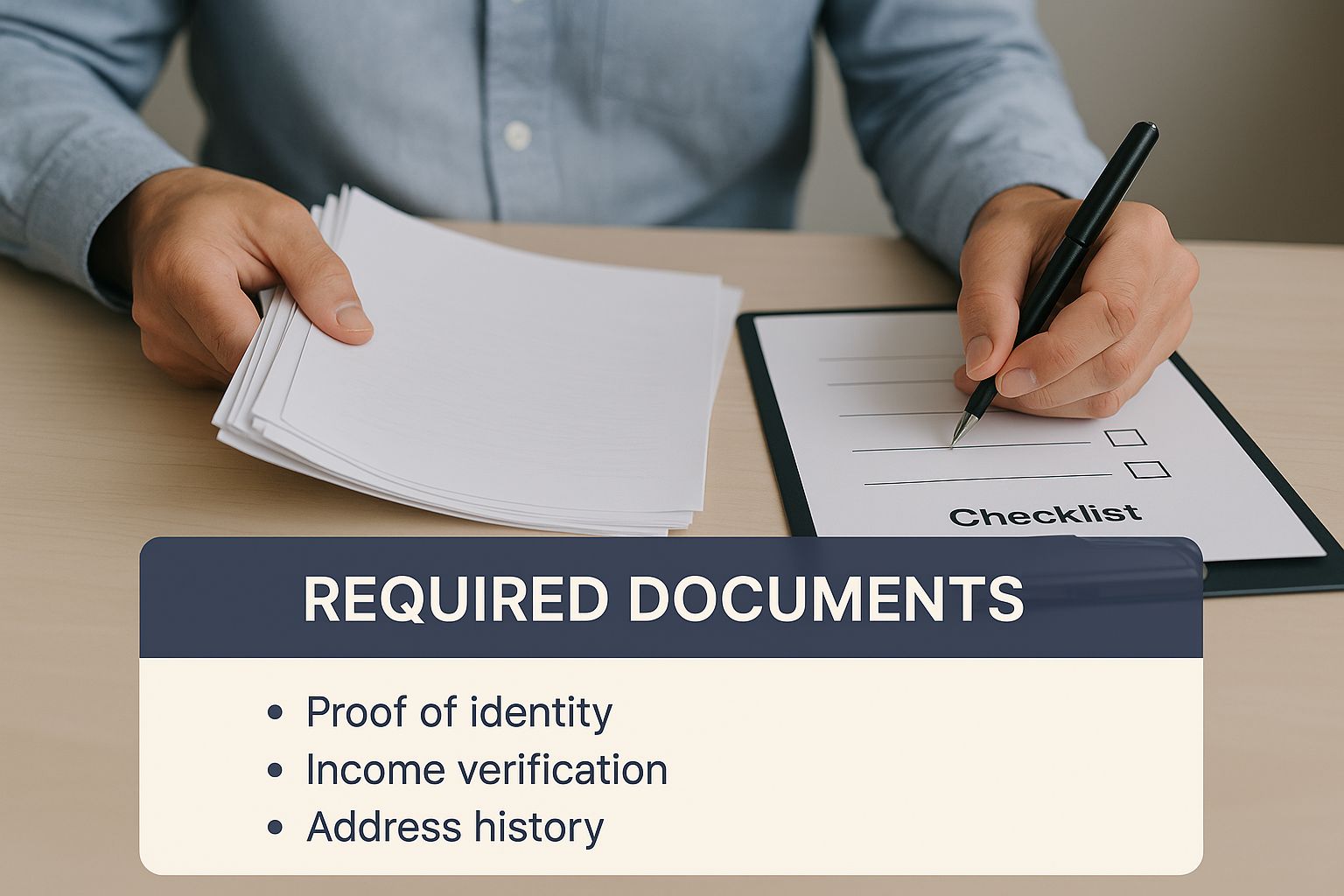
Getting this information organised upfront will make the entire registration process a whole lot smoother, no matter which structure you land on.
UK Business Structures at a Glance
Choosing the right structure is a balancing act, weighing personal protection against administrative effort. You need to think about your long-term goals. Are you planning to hire a team? Will you be looking for investment? If the answer is yes, incorporating as a limited company is often the smartest move.
Here's a quick comparison to help you see the key differences at a glance.
Feature | Sole Trader | Private Limited Company (Ltd) | Limited Liability Partnership (LLP) |
|---|---|---|---|
Personal Liability | Unlimited. Your personal assets are at risk. | Limited. Your personal assets are protected. | Limited. Partners' personal assets are protected. |
Tax | You pay Income Tax on profits via Self Assessment. | The company pays Corporation Tax. Directors are taxed on salary and dividends. | Partners are taxed individually on their share of profits via Self Assessment. |
Admin & Reporting | Minimal. Just an annual Self Assessment tax return. | More complex. Annual accounts and a Confirmation Statement filed with Companies House. | Similar to a limited company, requiring annual accounts and a Confirmation Statement. |
Credibility | Lower perceived credibility. | Higher perceived credibility, often preferred by clients and investors. | High credibility, common in professional services. |
Another option on the table is the Limited Liability Partnership (LLP). This is a bit of a hybrid, offering the tax transparency and operational feel of a partnership but with the limited liability of a company. It's a popular choice for professional firms like solicitors and accountants, where partners want that personal protection but also a direct slice of the profits.
Ultimately, there’s no single "best" answer only what's best for your business, your appetite for risk, and your future plans. And while you can always change your structure down the line (like moving from a sole trader to a limited company), it's far, far easier to get it right from day one.
Right, you've decided on your company structure. Excellent. Now comes the bit that can feel a little like homework: pulling together all the official details for your registration.
Think of this as gathering your ingredients before you start cooking. Getting everything sorted now is the single best thing you can do to make the actual registration process a breeze. A little prep here saves a lot of headaches later.
Nailing Down Your Company Name
Your company name is so much more than a label; it’s the cornerstone of your brand and a legal identifier. It absolutely must be unique and not tread on the toes of an existing name on the Companies House register.
Your first port of call should be the official Companies House name availability checker. It's free, instant, and tells you if your name is technically available. But don’t stop there. I’ve seen people get into trouble by skipping this next part: do a quick Google search and check social media. Is another business already using a similar name, even if they aren't a registered company? A few minutes of searching now can save you a world of pain and potential trademark disputes down the line.
Remember the rules, too. Your name will almost always need to end with 'Limited' or 'Ltd'. You also have to be careful with 'sensitive' words that suggest a connection to the government or a regulated body, like 'Royal', 'Bank', or 'Chartered'. You'll need special permission for those.
Choosing a Registered Office Address
Every UK company needs an official, registered office address. This isn't just a formality, it’s where all official mail from Companies House and HMRC will land, and it will be publicly displayed online.
A few things to keep in mind:
It has to be a real, physical address in the UK (that means England, Wales, Scotland, or Northern Ireland). A PO Box just won't cut it.
You can use your home address. Many founders do this to keep costs down at the start. The big downside? Your home address becomes public information.
A popular alternative is using a service provider's address or your accountant’s office. This keeps your home address private and can give your new venture a more professional sheen.
There's a trade-off here between the convenience of using your home and the privacy of a dedicated service. Think carefully about what's right for you.
Appointing Directors and Shareholders
You'll need to appoint at least one director to run the company and at least one shareholder to own it. For most start-ups, one person wears both hats, acting as the sole director and shareholder. It’s simple and it works.
For each director, you'll need to provide their:
Full name, date of birth, and nationality.
A service address (this is public, and can be the same as the registered office) and their home address (which is kept private).
For the shareholders (often called 'members'), you need to spell out who owns what. The shares represent ownership. For instance, a solo founder might issue themselves 100 shares at a nominal value of £1 each. If two co-founders are splitting the business down the middle, they might each take 50 shares.
Your decisions on directors and share structure are fundamental. They define who's in control and who reaps the rewards. Make sure everyone involved is in complete agreement on these details before you file.
By registering, you're joining a massive wave of new entrepreneurs. In the 2023-24 financial year alone, around 890,500 new businesses were registered in the UK, an 11.2% jump from the year before. This boom shows just how vibrant the UK start-up scene is. You can dig into more of this data by checking out the latest UK business statistics on Money.co.uk.
Understanding SIC Codes and Your Governing Documents
Almost there. You just need to sort out two final bits of admin.
First, your Standard Industrial Classification (SIC) code. This is a five-digit code that tells the world what your business actually does. You can pick up to four. For example, a new web design agency might choose (Business and domestic software development). You can find the full list of codes on the GOV.UK website.
Second, you'll need two core governing documents:
Memorandum of Association: This is just a standard, one-page declaration from the first shareholders confirming they want to form a company.
Articles of Association: These are the internal rules for running your company things like shareholder rights and director responsibilities. Most people just adopt the standard 'Model Articles' provided by Companies House. Unless you have very specific or complex needs, they work perfectly fine.
Once you have all these details collected and the key decisions made, you're ready. You can now move on to the final filing stage, confident that your application is solid, complete, and correct.
Navigating the Official Registration Process
You’ve done the groundwork, made the key decisions, and now it’s time to make it all official. This is the moment you formally introduce your new venture to Companies House. Everything you've done in figuring out how to register a company comes down to this final, crucial step.
The quickest, easiest, and cheapest way to get this done is by registering online through the GOV.UK website. It’s a slick process that costs just £50 and, in most cases, your company will be officially incorporated in a day or two.
Using the GOV.UK Online Service
Once you start the online application, you’ll be walked through a series of straightforward screens. Think of it as a digital version of the traditional paper form, asking for all the information you've already prepared: your chosen company name, registered office, director details, shareholder information, and your SIC code.
You'll need to create a Government Gateway user ID if you don't have one already. This is your key to a range of government services, so make sure you keep the login details somewhere safe. As you go through the application, be meticulous. Double-check every single entry for typos, particularly with names and addresses. A simple spelling mistake is the number one reason applications get held up or rejected.
Expert Tip: Before you hit that final 'submit' button, pause and carefully go over the summary page. It’s your last chance to spot any mistakes. Make absolutely sure the share structure matches what you've agreed with any co-founders and that all director service addresses are correct, as this information will be on the public record.
You’ll typically pay the fee with a debit or credit card. After that, you’ll get an email confirming your application has been received. The wait isn't usually long; most online applications are processed and approved within a single business day.
Other Registration Routes
While going online is the go-to method for most founders, it’s not your only option. There are a couple of other paths you can take, each with its own trade-offs.
Registering by Post (While It’s Still an Option): You can still go the old-school route by downloading and completing the paper ‘IN01’ form to register your company. However, this method is slower processing can take 8 to 10 working days and it costs more at £40. It’s really only a fallback for specific situations where online filing isn’t an option.
Heads-up: From March 2026, Companies House will phase out paper filings, including the IN01 form, as part of wider reforms to improve transparency and efficiency. After that, most company registrations will need to be done online only.
Using a Company Formation Agent: These are third-party services that will manage the entire registration for you. They often package the registration with other useful services, like providing a registered office address or helping set up a business bank account. You'll pay a fee on top of the Companies House cost, but for many, the peace of mind and expert support are well worth it.
The UK's entrepreneurial scene is always buzzing. To give you an idea, even with the usual monthly ebbs and flows, over 60,000 new companies were registered in May 2025 alone. It shows just how many founders are going through this exact process every single month. You can dive deeper into these figures and see how the business ecosystem is shaping up by exploring these UK business insights from Data Gardener.
Receiving Your Incorporation Documents
Once Companies House gives your application the green light, you'll receive an email with your official documents attached as PDFs. These are incredibly important, so your first job is to download them and file them away securely.
Here’s what you’ll get:
Certificate of Incorporation: This is your company's official birth certificate. It confirms the name, its unique registration number, and the date it was officially formed.
Memorandum and Articles of Association: These are the legal rulebooks you agreed to during the application that govern how your company will operate.
Your Company Registration Number (CRN) is a unique eight-digit code that you'll use in all your dealings with Companies House and HMRC. You'll need it for just about everything official, from filing your annual accounts to opening a business bank account. It’s also crucial to get to grips with the legal framework you're now part of; you can find out more by reading our comprehensive terms and conditions guide, which breaks down key compliance obligations.
What to Do After Your Company Is Registered

Holding your Certificate of Incorporation is a fantastic feeling. It feels like you’ve crossed the finish line, but in reality, you’ve just heard the starting gun. All the admin for how to register a company is done. Now the real work begins: running a compliant, successful business. Your focus has to shift immediately from formation to operation.
Those first few weeks are absolutely critical. This is when you lay the financial and legal foundations that will support your company as it grows. I’ve seen countless new founders get this wrong, and neglecting these early jobs can create massive headaches later, from messy accounts to painful penalties from HMRC or Companies House.
Let’s walk through what you need to do, right now.
Your Immediate Financial Checklist
First things first: get your company’s financial identity set up and kept completely separate from your own. Trust me on this mixing business and personal funds is a recipe for disaster. It makes accounting a nightmare and can even threaten the limited liability protection you worked so hard to get.
Here are the absolute non-negotiables:
Open a Business Bank Account: This isn't a suggestion; it's essential. A dedicated account keeps every company transaction separate and clean. When you're comparing banks, don't just look at the monthly fees. Consider how good their online banking is, whether they integrate with accounting software, and what kind of business support they offer.
Set Up Your Accounting System: You need a system from day one. It could be simple spreadsheets to start, or you could jump straight into cloud software like Xero or QuickBooks. Good record-keeping isn't just for your accountant, it’s your real-time dashboard for the company’s financial health.
A Word of Advice: Don't put off your bookkeeping. Seriously. Log every single expense and invoice, no matter how small. That £3 coffee you bought during a client meeting? It's a legitimate business expense, but only if you actually record it properly.
Getting Registered with HMRC for Tax
Companies House might know you exist, but they don't tell HMRC everything automatically. You have a legal duty to register for various taxes yourself, and the clock is ticking.
You must register for Corporation Tax with HMRC within three months of starting to trade. "Starting to trade" is a broad term. It could be the moment you buy your first bit of stock, make your first sale, or even just start advertising your services. My advice? Just get it done as soon as you're incorporated to avoid forgetting and facing penalties.
The registration is done online. You'll need your company’s 10-digit Unique Taxpayer Reference (UTR), which HMRC will post to your registered office address, usually within a couple of weeks of incorporation.
Understanding Your Annual Obligations
As a company director, you are now legally on the hook for filing key documents with Companies House and HMRC every single year. Missing these deadlines isn't an option. It leads to automatic fines, and in serious cases, your company could be struck off the register.
Your main annual duties are:
Confirmation Statement: Think of this as your annual check-in with Companies House. You're simply confirming that the information they have on file (directors, shareholders, registered office, etc.) is correct. There's a small filing fee, and you must file it even if nothing has changed.
Annual Accounts: This is a much more detailed report on your company’s finances. It needs to be prepared and filed with both Companies House and HMRC each year. Unless you're an accountant yourself, you'll almost certainly need professional help here.
Company Tax Return: This goes to HMRC along with your annual accounts. It’s the document used to calculate how much Corporation Tax your company owes.
Building a new venture from the ground up is an incredible journey. If you want to learn more about the team dedicated to helping businesses succeed from the very beginning, you can read more about the mission driving us at Day One Business. This commitment is about supporting you through every stage, including these crucial post-registration steps.
Your Top Company Registration Questions Answered
Starting a new company is exciting, but it’s natural to have questions. In my experience, clearing up a few common uncertainties can make the whole process feel much more manageable. Let’s tackle some of the most frequent queries I hear from founders.
How Long Does It Take to Register a Company in the UK?
Honestly, the speed of UK company registration often surprises people. It's one of the most efficient systems in the world.
If you file your application online via the GOV.UK portal, it's incredibly fast. Assuming all your details are correct and your proposed company name is available, you can expect an approval in under 24 hours. It’s not uncommon to get your official Certificate of Incorporation the very same day.
The story changes if you opt for a postal application. That route is much slower, typically taking 8 to 10 days to process. This significant delay is exactly why more than 95% of founders stick with the online method.
Can I Register a Company from Outside the UK?
Yes, absolutely. The UK is very welcoming to international entrepreneurs. There are no rules stopping a non-resident from being a director or shareholder of a UK limited company.
There is one crucial catch, though.
Your company must have a registered office address in the UK. This needs to be a real, physical address in England and Wales, Scotland, or Northern Ireland a PO Box simply won’t do.
This is a strict legal requirement. For founders living abroad, the most practical solution is often a registered office address service. These providers give you a compliant UK address for all your official mail from Companies House and HMRC, keeping you on the right side of the law while you run your business from anywhere in the world.
What Is the Difference Between a Director and a Shareholder?
Getting your head around this is key to understanding how a limited company works. While one person can be both, the roles are distinct.
Directors run the company. They're in charge of the day-to-day management, making business decisions, and are legally responsible for things like filing accounts and paying taxes. Think of them as the managers.
Shareholders own the company. Their ownership is tied to the number of shares they hold. Their influence comes from voting on big-picture decisions, like appointing or removing directors. Think of them as the owners.
For most small businesses and startups, the founder starts out as the sole director and the sole shareholder. This setup gives you total control. As the business grows, you might bring on new shareholders (like investors) or hire expert directors who don't own shares, and that’s when the distinction becomes much more important.
Do I Need an Accountant to Register My Company?
The short answer is no, you’re not legally required to use an accountant. The online registration process is designed to be simple enough for anyone to handle on their own.
But just because you can do it yourself doesn't always mean it's the best move.
Hiring an accountant before you even register can be a brilliant early investment. They do much more than fill in forms. A good accountant can advise on the most tax-efficient structure for your specific goals and help you get to grips with your future responsibilities like Corporation Tax, VAT, and PAYE.
It’s an upfront cost, for sure, but their guidance can save you from making expensive mistakes down the line. I always tell founders to see it as an investment in building your business on solid financial ground from the very beginning.
At Day One Business, we know that registering your company is just the beginning. Our mission is to give you the support you need to handle your new responsibilities with confidence, from securing a professional business address to managing ongoing compliance. Let us help you build a strong foundation for success from day one. Learn more at Day One Business.

Comments